Born With a Retrograde Planet: Mercury, Venus or Mars Retrograde in the Natal Chart
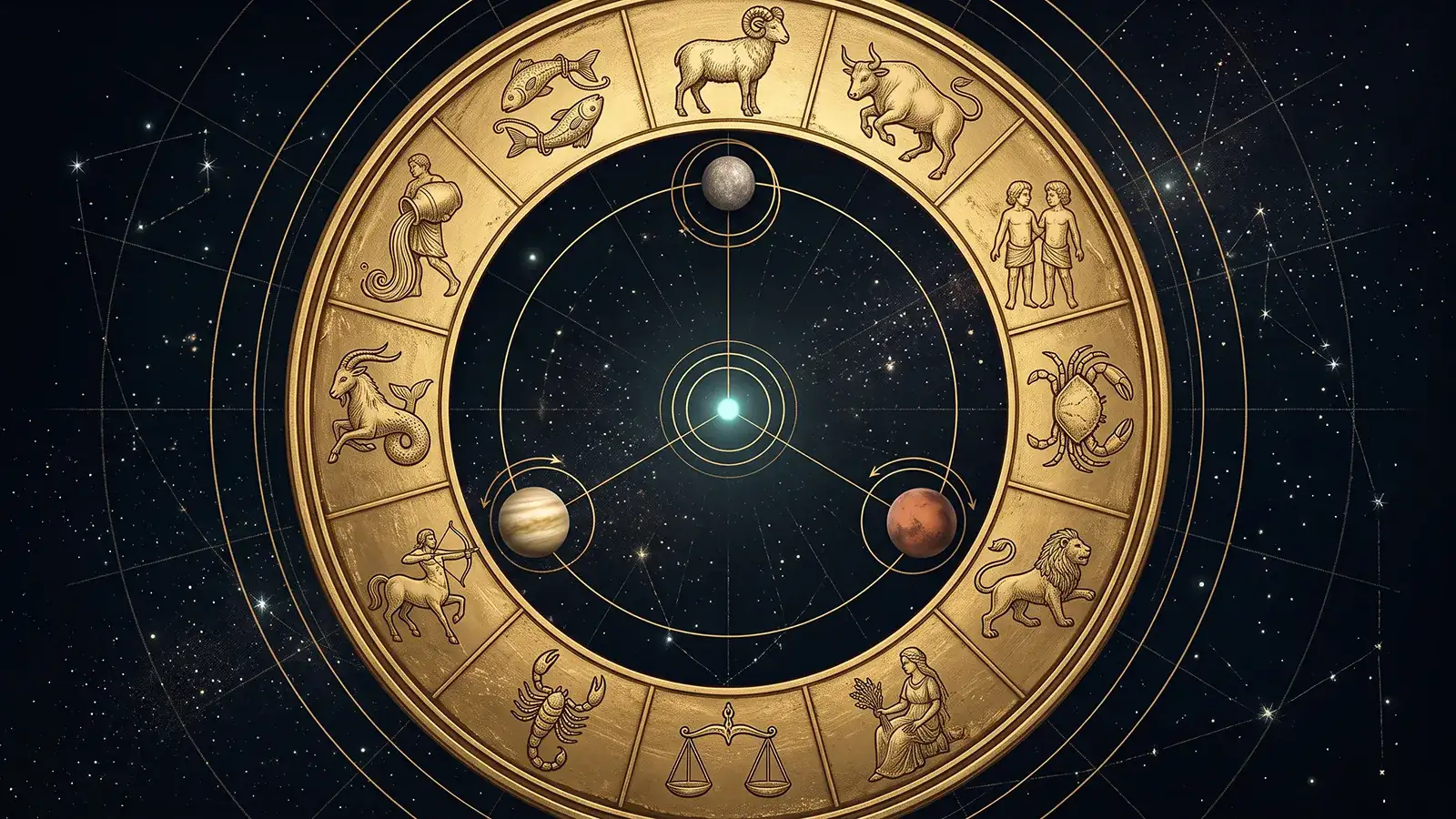
On your natal chart, a small “R” or the symbol ℞ may sit next to Mercury, Venus or Mars. It means the planet was retrograde on the day you were born: seen from Earth, it appeared to move backward through the zodiac. That is neither a glitch nor bad luck. Between 1950 and 2026, nearly one person in five was born with Mercury retrograde, and nearly nine in ten have at least one retrograde planet in their chart.
This article explains what a natal retrograde really describes, why it is so common, how to check yours in two minutes, and what it changes for Mercury, Venus, Mars and the outer planets. For Venus and Mars, it also lists every birth period affected since 1960. The retrogrades that come and go — Mercury backing up three times a year for everyone — live on our retrogrades page. Here we are talking about the one that never moves again: yours.
A retrograde planet in the natal chart is not a weakened planet: it is a planet on a delay. Its function — thinking for Mercury, loving and valuing for Venus, acting for Mars — plays out inward first, at your own pace, often later and more personally than the norm. It is common: 19% of births for Mercury, 7% for Venus, 9% for Mars, 30% for Jupiter and 37% for Saturn. To find out, your birth date is enough; the time only matters if you were born on the exact day of a station.
What is a retrograde planet in the natal chart?
A planet is natally retrograde when, at the moment of your birth, it appeared to be moving backward through the zodiac as seen from Earth. No planet actually reverses: it is a trick of perspective, like a car you pass on the highway that seems to slide backward in your window. In a natal chart, that state is frozen for good, like your Sun sign or the position of your Moon.
It happens when Earth and the planet sit on the same side of the Sun, at their closest to each other. For Mercury and Venus, that is when they pass between Earth and the Sun; for Mars and the planets beyond, it is when Earth overtakes them on the inside lane. In other words, a natal retrograde planet is a planet that was as close to you as it ever gets on the day you were born. Mars retrograde even shines brighter than at any other time: it is the Mars of oppositions, red and visible all night long.
On a printed chart or on screen, you spot a retrograde by the ℞ symbol (or a plain “R”) next to the planet, sometimes by a color or a “retrograde” label in the table of positions. The Sun and Moon are never retrograde. The seven other planets, Mercury through Neptune, plus Pluto, go retrograde regularly, each at its own rhythm — and that rhythm is why natal retrogrades are so widespread.
How common is it? The numbers, planet by planet
We checked, for every day from January 1, 1950 to December 31, 2026, which planets were retrograde. The result fits in one table: the farther a planet is from the Sun, the more time it appears to spend moving backward, and the more ordinary it is to have it retrograde at birth.
| Planet | Share of births | How often | Length of one retrograde |
|---|---|---|---|
| Mercury | 19% | 3 times a year, sometimes 4 | 19 to 24 days |
| Venus | 7% | about every 19 months | 40 to 43 days |
| Mars | 9% | every 25 to 26 months | 60 to 81 days |
| Jupiter | 30% | once a year | about 4 months |
| Saturn | 37% | once a year | about 4½ months |
| Uranus | 41% | once a year | about 5 months |
| Neptune | 44% | once a year | a little over 5 months |
| Pluto | 43% | once a year | a little over 5 months |
The percentages are the share of days in the period when the planet was retrograde — so, very nearly, the share of people born with that planet retrograde. Venus is the rarest of the three personal planets: just 7%. The outer planets, by contrast, affect anywhere from nearly one person in three to nearly one in two. That is why their natal retrograde carries little weight in an individual portrait: you share it with a whole slice of your generation.
Second question, and one we hear a lot: how many retrograde planets does a person usually have? Counting all eight planets, Mercury through Pluto:
| Retrograde planets at birth | Share of births |
|---|---|
| None | 11% |
| One | 22% |
| Two | 22% |
| Three | 22% |
| Four | 16% |
| Five or more | 7% |
The “no retrograde planets” case, which some sites present as a mark of exception, applies to one person in nine. Two or three retrogrades is the norm. And if you look only at Mercury, Venus and Mars, the three so-called personal planets: two people in three have none of them retrograde, 29% have one, 3.5% have two. All three at once? Across the 28,000 days we sifted through, it never happened.
How to check your natal chart
The simplest way is to run your chart through our free natal chart calculator: in the table of positions, every retrograde planet carries the ℞ symbol. If you don’t know your birth time, enter noon: the Ascendant and houses will be off, but not the retrograde. If you already have a chart in front of you, look for the ℞ or the letter R next to the planets, or a “motion” column.
Reassuring news for anyone without a birth time: a retrograde depends only on the date. A planet moving backward in the morning is still moving backward that evening. The one exception is the exact day of a station, when the planet changes direction: on that day, the hour decides. For Mercury, that happens six to eight days a year; for Venus, a little more than one day a year on average. On every other day, the date is enough, and the tables in this article give you the answer for Venus and Mars without any math.
If you were born abroad, or in another time zone, keep in mind that the station dates given here are in Eastern Time (New York). A station at 7:20 pm Eastern is already the next day in London or Berlin; in Pacific Time it falls three hours earlier, at 4:20 pm, on the same date. Here again, this only matters on the day of the station itself.
The planet on a delay: how to read a natal retrograde
Here is the framework we use at ZodiacNova. A natal retrograde planet works on a delay: its function is intact, but it runs inward first, with a time lag, and by rules the person sets for themselves rather than the rules of the people around them. Three signs give it away.
Internalizing. Whatever the planet governs is lived inside first. With Mercury retrograde, you think before you speak, and you often say less than you think. With Venus, you feel deeply and show little. With Mars, anger or drive gets digested before it comes out — if it comes out.
The time lag. The function matures later than in other people, or shows up off the beat. The child who “didn’t talk much” becomes the best writer in the family. The person who didn’t love the way their friends did at twenty finds their own way at thirty-five. Nothing is running late; the clock is simply personal.
Revision. A retrograde planet retraces its steps. In a chart, that becomes a need to reread, reassess and redo, and an instinctive distrust of ready-made answers. It is the gift of proofreaders, researchers, and the people who notice what everyone else let slip by.
How much weight does it carry? As with any planet: it depends on the sign, the house and the aspects. A retrograde Venus conjunct the Ascendant or ruling the chart makes itself felt every day; an isolated retrograde Venus in the 12th house, far less. And a natal retrograde is never read on its own: it colors a planet, it does not replace it. On this site we prefer to understand rather than predict, and the natal retrograde is a good example of something that is easy to understand and hard to predict.
Three myths to let go of
“A retrograde planet is a weak planet.” Medieval astrology filed retrogradation among the debilities, alongside combustion and detriment. Modern, more psychological astrology sees a different orientation rather than a loss. The numbers back the second reading: with 37% of people carrying Saturn retrograde and 44% Neptune retrograde, you would have to accept that a good part of humanity walks around with “broken” planets. That is not what we observe.
“It’s karmic — it comes from a past life.” This reading gets around a lot, especially for Venus and Saturn. It is neither verifiable nor necessary: everything a natal retrograde describes can be seen in this life, in how the person thinks, loves or acts. We set it aside, without judging those it helps.
“Born during Mercury retrograde? You’ll have communication problems.” One person in five was born during Mercury retrograde. If the sentence were true, it would describe a fifth of your coworkers, your friends and your favorite authors. What natal Mercury retrograde describes is a way of communicating, often more deliberate, more written or more visual than average — not a flaw.
Mercury retrograde in the natal chart: thinking before speaking
☿ Mercury governs thought, speech, learning and exchange. Retrograde at birth, as it is for 19% of people, it describes a mind that works from the inside first. You take everything in, sort it for a long time, and speak when it is ready. Many people with this placement recognize themselves in one sentence: “I know exactly what I think, but not always how to say it in the moment.”
In practice, natal Mercury retrograde often shows up as a preference for writing, where you can reread and correct; as learning that follows its own route rather than the assigned method; and as a memory that is selective but deep: what was understood once stays understood. The flip side is a sense of lagging behind in fast conversations, or of being misread when you rush. One observation many practitioners report: people born with Mercury retrograde often handle the periods when Mercury goes retrograde for everyone better than most — the rhythm is familiar to them.
Mercury’s sign sharpens the picture: a retrograde Mercury in Gemini or Virgo, the signs it rules, keeps all its agility but turns it toward analysis; in Scorpio, it digs; in Pisces, it thinks in images. To check yours, see the planet page for Mercury and, for the mechanics of the phenomenon, our page on Mercury retrograde.
Were you born during Mercury retrograde?
Mercury moves backward three to four times a year for about three weeks: the full list since 1960 would run to more than two hundred periods, and the calculator will answer faster. For recent births, here are the periods since late 2023, in Eastern Time. On the day of a station, the birth time decides.
| Turns retrograde | Turns direct | Sign(s) |
|---|---|---|
| December 13, 2023 | January 1, 2024 | Capricorn → Sagittarius |
| April 1, 2024 | April 25, 2024 | Aries |
| August 5, 2024 | August 28, 2024 | Virgo → Leo |
| November 25, 2024 | December 15, 2024 | Sagittarius |
| March 15, 2025 | April 7, 2025 | Aries → Pisces |
| July 18, 2025 | August 11, 2025 | Leo |
| November 9, 2025 | November 29, 2025 | Sagittarius → Scorpio |
| February 26, 2026 | March 20, 2026 | Pisces |
| June 29, 2026 | July 23, 2026 | Cancer |
| October 24, 2026 | November 13, 2026 | Scorpio |
| February 9, 2027 | March 3, 2027 | Pisces → Aquarius |
| June 10, 2027 | July 4, 2027 | Cancer → Gemini |
| October 7, 2027 | October 28, 2027 | Scorpio → Libra |
| January 24, 2028 | February 14, 2028 | Aquarius |
| May 21, 2028 | June 14, 2028 | Gemini |
| September 19, 2028 | October 11, 2028 | Libra |
A detail astrologers note in passing: a natal Mercury retrograde is always close to the Sun, within about twenty degrees, and often conjunct it. Mercury’s retrograde brackets its inferior conjunction, the moment the planet passes exactly between Earth and the Sun. Many people with this placement therefore have Mercury retrograde in the same sign as their Sun, which deepens the “think before you speak” shade of the Sun sign.
Venus retrograde in the natal chart: loving your own way
♀ Venus governs affection, taste, and the value you place on yourself and on things. Retrograde at birth, it is the rarest of the three personal planets: 7% of births. It describes someone who loves deeply but by their own rules, and who takes time to trust what they feel — or to show it.
The recurring themes are familiar to practitioners: a feeling, in childhood or adolescence, of not loving “like everyone else”; tastes that run against fashion; a tendency to reassess relationships after the fact, and to circle back to people or places you thought you had left behind; a self-worth that builds from the inside, slowly, and then becomes very solid because it depends on no one. In love, natal Venus retrograde means neither loneliness nor bad luck: it means choosing late, and choosing for yourself.
There is a beautiful and exact astronomical image behind all this. Venus retrograde brackets its inferior conjunction, the passage between Earth and the Sun. Before it, Venus is the evening star; after it, the morning star. To be born with Venus retrograde is to be born while Venus is switching skies. For the planet itself, see our Venus page; for the phenomenon and its dates, Venus retrograde.
The five Venus zones
Venus retrograde has a property neither Mercury nor Mars shares: its retrogrades repeat in almost the same spot every eight years, slipping back a little more than two degrees each time. Since 1960 they have therefore always fallen in one of five zones of the zodiac, five seasons of the year. If you have Venus retrograde in your chart, people born eight, sixteen or twenty-four years before or after you, in the same season, have it too, within a few degrees. They are your Venus cousins.
| Zone | Season | Recent years |
|---|---|---|
| Aries – Pisces | March – April | 1993, 2001, 2009, 2017, 2025 |
| Gemini – Cancer | May – July | 1996, 2004, 2012, 2020, 2028 |
| Leo – Virgo | July – September | 1991, 1999, 2007, 2015, 2023 |
| Scorpio – Libra | October – November | 1994, 2002, 2010, 2018, 2026 |
| Capricorn – Aquarius | December – February | 1997-98, 2005-06, 2013-14, 2021-22, 2029-30 |
Were you born during Venus retrograde? Every period since 1960
The dates are those of the stations in Eastern Time: if your birth date falls between the two, Venus is retrograde in your chart. On a station day, check the time. The right-hand column gives Venus’s sign at the start and end of the period; your Venus is in one of the two.
| Turns retrograde | Turns direct | Sign(s) |
|---|---|---|
| March 20, 1961 | May 2, 1961 | Aries |
| October 23, 1962 | December 3, 1962 | Scorpio |
| May 29, 1964 | July 11, 1964 | Cancer → Gemini |
| January 5, 1966 | February 15, 1966 | Aquarius → Capricorn |
| August 8, 1967 | September 20, 1967 | Virgo → Leo |
| March 18, 1969 | April 29, 1969 | Aries |
| October 20, 1970 | November 30, 1970 | Scorpio |
| May 26, 1972 | July 9, 1972 | Cancer → Gemini |
| January 3, 1974 | February 13, 1974 | Aquarius → Capricorn |
| August 6, 1975 | September 17, 1975 | Virgo → Leo |
| March 15, 1977 | April 27, 1977 | Aries |
| October 17, 1978 | November 28, 1978 | Scorpio |
| May 24, 1980 | July 6, 1980 | Cancer → Gemini |
| December 31, 1981 | February 10, 1982 | Aquarius → Capricorn |
| August 3, 1983 | September 15, 1983 | Virgo → Leo |
| March 13, 1985 | April 24, 1985 | Aries |
| October 15, 1986 | November 25, 1986 | Scorpio |
| May 22, 1988 | July 4, 1988 | Cancer → Gemini |
| December 29, 1989 | February 8, 1990 | Aquarius → Capricorn |
| August 1, 1991 | September 13, 1991 | Virgo → Leo |
| March 11, 1993 | April 22, 1993 | Aries |
| October 13, 1994 | November 23, 1994 | Scorpio |
| May 20, 1996 | July 2, 1996 | Gemini |
| December 26, 1997 | February 5, 1998 | Aquarius → Capricorn |
| July 29, 1999 | September 10, 1999 | Virgo → Leo |
| March 8, 2001 | April 20, 2001 | Aries |
| October 10, 2002 | November 21, 2002 | Scorpio |
| May 17, 2004 | June 29, 2004 | Gemini |
| December 24, 2005 | February 3, 2006 | Aquarius → Capricorn |
| July 27, 2007 | September 8, 2007 | Virgo → Leo |
| March 6, 2009 | April 17, 2009 | Aries → Pisces |
| October 8, 2010 | November 18, 2010 | Scorpio → Libra |
| May 15, 2012 | June 27, 2012 | Gemini |
| December 21, 2013 | January 31, 2014 | Capricorn |
| July 25, 2015 | September 6, 2015 | Virgo → Leo |
| March 4, 2017 | April 15, 2017 | Aries → Pisces |
| October 5, 2018 | November 16, 2018 | Scorpio → Libra |
| May 13, 2020 | June 25, 2020 | Gemini |
| December 19, 2021 | January 29, 2022 | Capricorn |
| July 22, 2023 | September 3, 2023 | Leo |
| March 1, 2025 | April 12, 2025 | Aries → Pisces |
| October 3, 2026 | November 13, 2026 | Scorpio → Libra |
| May 10, 2028 | June 22, 2028 | Gemini |
You may have noticed: there is no Venus retrograde in 2027. After the one from October 3 to November 13, 2026, the next will wait until May 10, 2028, in Gemini.
Mars retrograde in the natal chart: slow to start, hard to stop
♂ Mars governs action, desire, anger and how you defend yourself. Retrograde at birth — 9% of births — it describes an energy that gets going slowly and, once launched, lasts longer than anyone else’s. The image people with this placement reach for most often: the diesel engine. No screeching start, but remarkable staying power.
Day to day, that means an aversion to open conflict and an anger that gets digested before it comes out, sometimes long after the moment it would have been useful. It also means real strategic strength: you act when you are sure, you don’t waste effort, you finish what you start. The pitfall is well known: energy turned back on yourself, as tension or inner reproach, when it finds no outlet. Endurance sports, hands-on work and long projects suit it better than sprints.
Another astronomical detail: Mars retrograde brackets its opposition to the Sun, the moment the planet is closest to Earth and brightest in the sky. People born with Mars retrograde were born under the most visible Mars of its cycle. For the planet, see Mars; for the phenomenon, Mars retrograde.
Were you born during Mars retrograde? Every period since 1960
Mars moves backward every twenty-five to twenty-six months, for two to almost three months. The length depends on the sign: the longest Mars retrogrades, eighty days, happen in Leo, Virgo and Libra; the shortest, sixty days, in Aquarius and Pisces. Station dates in Eastern Time.
| Turns retrograde | Turns direct | Sign(s) |
|---|---|---|
| November 20, 1960 | February 5, 1961 | Cancer → Gemini |
| December 26, 1962 | March 16, 1963 | Leo |
| January 28, 1965 | April 19, 1965 | Virgo |
| March 8, 1967 | May 26, 1967 | Scorpio → Libra |
| April 27, 1969 | July 8, 1969 | Sagittarius |
| July 11, 1971 | September 9, 1971 | Aquarius |
| September 19, 1973 | November 25, 1973 | Taurus → Aries |
| November 6, 1975 | January 20, 1976 | Cancer → Gemini |
| December 12, 1977 | March 2, 1978 | Leo → Cancer |
| January 16, 1980 | April 6, 1980 | Virgo → Leo |
| February 20, 1982 | May 11, 1982 | Libra |
| April 5, 1984 | June 19, 1984 | Scorpio |
| June 8, 1986 | August 12, 1986 | Capricorn |
| August 26, 1988 | October 28, 1988 | Aries → Pisces |
| October 20, 1990 | January 1, 1991 | Gemini → Taurus |
| November 28, 1992 | February 15, 1993 | Cancer |
| January 2, 1995 | March 24, 1995 | Virgo → Leo |
| February 5, 1997 | April 27, 1997 | Libra → Virgo |
| March 18, 1999 | June 4, 1999 | Scorpio → Libra |
| May 11, 2001 | July 19, 2001 | Sagittarius |
| July 29, 2003 | September 27, 2003 | Pisces |
| October 1, 2005 | December 9, 2005 | Taurus |
| November 15, 2007 | January 30, 2008 | Cancer → Gemini |
| December 20, 2009 | March 10, 2010 | Leo |
| January 23, 2012 | April 13, 2012 | Virgo |
| March 1, 2014 | May 19, 2014 | Libra |
| April 17, 2016 | June 29, 2016 | Sagittarius → Scorpio |
| June 26, 2018 | August 27, 2018 | Aquarius → Capricorn |
| September 9, 2020 | November 13, 2020 | Aries |
| October 30, 2022 | January 12, 2023 | Gemini |
| December 6, 2024 | February 23, 2025 | Leo → Cancer |
| January 10, 2027 | April 1, 2027 | Virgo → Leo |
| February 14, 2029 | May 5, 2029 | Libra → Virgo |
The next one is close: January 10 to April 1, 2027, from Virgo back into Leo, the only Mars retrograde between 2025 and 2029. Children born during those twelve weeks will have Mars retrograde in their chart — more on that below.
Jupiter, Saturn and the outer planets: a generation’s retrograde
From Jupiter outward, the natal retrograde changes in nature. It applies to 30% of births for Jupiter, 37% for Saturn and more than 40% for Uranus, Neptune and Pluto: no longer a personal trait, but one shared with everyone born during the same four or five months of the year. It deserves a reading, but a proportionate one.
Natal Jupiter retrograde describes a confidence and a worldview built from the inside rather than by signing on: you distrust dogma, easy promises and group optimism, and you work out your own philosophy. Jupiter’s “luck” then comes less from outside opportunities than from inner conviction, often later in life. See Jupiter and Jupiter retrograde.
Natal Saturn retrograde is the most searched of the five, and the most misunderstood. Tradition reads it as an authority you have to build for yourself rather than receive: outside rules are not enough, you have to make them your own before you can believe in them. That often produces adults who are very demanding of themselves, who take time to feel legitimate and then become pillars for others. It is not a curse about the father, nor a handicap: more than one person in three has it. See Saturn and Saturn retrograde.
Uranus, Neptune and Pluto retrograde are almost never read on their own: at 41%, 44% and 43% of births, they are part of the generational backdrop. They matter mostly when the planet is angular, conjunct the Sun or Moon, or ruling an angle. The retrograde then deepens the already inward note of these planets: an originality lived in private for Uranus, a sensitivity that goes unspoken for Neptune, a controlled intensity for Pluto.
Special cases
No retrograde planets
One person in nine. Tradition sees a more direct, more outgoing nature here, an energy that goes out to the world first. It is neither better nor worse than the general case; it is simply a chart where everything moves in the same direction, and where revision will have to come from somewhere else — the signs, the houses, the aspects, or plain experience.
Four or more retrograde planets
More than one person in five, since 16% have four and 7% have five or more. Six retrograde planets is still rare (a little over 1%); seven, we did not find once between 1950 and 2026. A heavily retrograde chart describes a strongly inward person who lives at their own pace and whose richness does not show right away. They need time, and people who know how to wait. Look at which planets are involved: four retrograde outer planets say far less than a retrograde Mercury and Mars.
A stationary planet at birth
If you were born on the day of a station, or within a day of it — the moment the planet stops to change direction — your planet is said to be stationary. Astrologers give it special weight: motionless in the sky, it carries the chart like an angular planet. A retrograde station (the planet stops to move backward) marks the start of a turn inward; a direct station (it moves forward again) marks the way out of that turn, an energy restarting. This is the one case where your birth time changes how a retrograde is read.
The Sun, the Moon, the nodes and the rest
The Sun and Moon never go retrograde: if a site tells you about a “retrograde Sun,” close the tab. The lunar nodes, on the other hand, move backward almost all the time; retrograde motion is their normal state, and a “direct” node is the real curiosity. Chiron and the asteroids go retrograde like the planets, but reading them is beyond the scope of this article.
Born in late 2026 or in 2027: the windows worth knowing
If you are expecting a child, or reading this for a baby who just arrived, here is what the sky has in store. Fall 2026 is unusual: Venus is retrograde from October 3 to November 13, 2026 (direct station at 7:20 pm Eastern Time), and Mercury joins it from October 24 to November 13. Children born between October 24 and November 13, 2026 will therefore have both Mercury and Venus retrograde in their chart, a combination found in only 1.3% of births. We covered this double retrograde in detail in our article on Venus retrograde in Scorpio 2026.
Then comes Mars retrograde, from January 10 to April 1, 2027, from Virgo back into Leo: every child born during those twelve weeks will have Mars retrograde at birth. Mercury moves backward three times in 2027 — February 9 to March 3, June 10 to July 4, October 7 to 28 — and Venus not once. The table below gathers every window, outer planets included, in Eastern Time.
| Planet | Turns retrograde | Turns direct | Sign(s) |
|---|---|---|---|
| Venus | October 3, 2026, 3:10 am | November 13, 2026, 7:20 pm | Scorpio → Libra |
| Mercury | October 24, 2026, 3:15 am | November 13, 2026, 10:52 am | Scorpio |
| Jupiter | December 12, 2026, 7:58 pm | April 12, 2027, 10:13 pm | Leo |
| Mars | January 10, 2027, 8:00 am | April 1, 2027, 10:11 am | Virgo → Leo |
| Mercury | February 9, 2027, 12:35 pm | March 3, 2027, 7:34 am | Pisces → Aquarius |
| Pluto | May 8, 2027, 8:14 am | October 17, 2027, 11:51 pm | Aquarius |
| Mercury | June 10, 2027, 2:18 pm | July 4, 2027, 3:40 pm | Cancer → Gemini |
| Neptune | July 9, 2027, 6:50 pm | December 15, 2027, 4:43 am | Aries |
| Saturn | August 9, 2027, 1:52 pm | December 23, 2027, 9:49 pm | Aries |
| Uranus | September 15, 2027, 5:15 am | February 12, 2028, 6:40 pm | Gemini |
| Mercury | October 7, 2027, 10:40 am | October 28, 2027, 10:10 am | Scorpio → Libra |
A baby born with Venus or Mars retrograde is not “complicated”: for loving or for acting, they will simply have an inner clock that is better respected than rushed. The rest of the chart — the Moon sign, the Ascendant, the aspects — will say far more than the retrograde alone. And when they want to check for themselves in a few years, the calculator will still be here.
To place these windows in the wider sky of 2027, see our Mercury retrograde 2027 calendar and our guide Astrology 2027: the dates that matter.
Frequently asked questions about retrograde planets in the natal chart
How do I know if I have a retrograde planet in my natal chart?
Run your chart through a natal chart calculator: retrograde planets are marked with the ℞ symbol or the letter R. For Venus and Mars, the tables in this article list every period since 1960: if your birth date falls between the two dates on a row, that planet is retrograde in your chart. You only need your birth time if you were born on the exact day of a station.
What does Mercury retrograde in the natal chart mean?
Natal Mercury retrograde describes a mind that works from the inside first: you think before you speak, often prefer writing to talking, learn by your own route and reread everything. It is not a communication problem: 19% of people were born with Mercury retrograde. It is a way of communicating, more deliberate, and sometimes a step behind in fast exchanges.
What does Venus retrograde in the natal chart mean for love?
Natal Venus retrograde, found in 7% of people, describes a very personal way of loving: you feel deeply, show little, take time to trust, and often choose late — but for yourself. Tastes tend to run against the current, and self-worth is built from the inside. It predicts neither loneliness nor bad luck; it describes a rhythm, not a verdict.
Does Mars retrograde in the natal chart mean low energy?
No. Natal Mars retrograde, found in 9% of people, describes an energy that starts slowly and lasts a long time, an anger digested before it is expressed, and real endurance. The risk is turning that energy against yourself when it finds no outlet; the asset is a strategic strength that finishes what it starts. Long projects and endurance sports suit it better than sprints.
Is it rare to have no retrograde planets in your chart?
A little: by our count over the years 1950 to 2026, 11% of people have no retrograde planet among the eight, Mercury through Pluto — about one in nine. The most common case is having one, two or three (22% each). A chart with no retrogrades describes an energy that goes out to the world first; it is neither better nor worse.
How many retrograde planets is a lot?
Four or more is already above average: about one person in five. In theory you could have eight, Mercury through Pluto, since the Sun and Moon never go retrograde. In practice, between 1950 and 2026, nobody was born with more than six retrograde planets, and six applies to just over 1% of births. Mercury, Venus and Mars all retrograde at once did not happen a single time in that period.
Is a retrograde planet in the natal chart weaker?
No, it is oriented differently. Medieval astrology counted retrogradation among the debilities; modern astrology sees a planet on a delay, whose function works inward first, with a time lag and by personal rules. The numbers point the same way: 37% of people have Saturn retrograde and 44% have Neptune retrograde, which would be a lot of “weak” planets for humanity to carry.
What does Saturn retrograde in the natal chart mean?
Natal Saturn retrograde describes an authority and a discipline you build yourself rather than receive: outside rules are not enough, you have to make them your own. That produces adults who are demanding of themselves, slow to feel legitimate, then very solid. Found in 37% of people, it is neither a curse nor a handicap, and it is always read together with Saturn’s sign, house and aspects.
Will babies born in late 2026 have Venus retrograde?
Yes, for births from October 3, 2026 (3:10 am Eastern Time) to November 13, 2026 (7:20 pm). From October 24 to November 13, Mercury is retrograde as well, which gives both planets retrograde at once, a combination present in 1.3% of births. Venus does not go retrograde in 2027; the next one begins May 10, 2028. Mars, meanwhile, will be retrograde from January 10 to April 1, 2027.
Going further
A natal retrograde is one of the few points in a chart you can check without a birth time and without any math, with a glance at the tables on this page. The next step is to read it in context: run your full natal chart to see the sign, house and aspects of the planet in question, and, if you know your birth time, your rising sign, which shows where that planet expresses itself in your life. For current and upcoming retrogrades, our retrogrades page keeps the calendar. A retrograde planet in your natal chart is not a planet you are missing; it is a planet that waited for you.